The short version
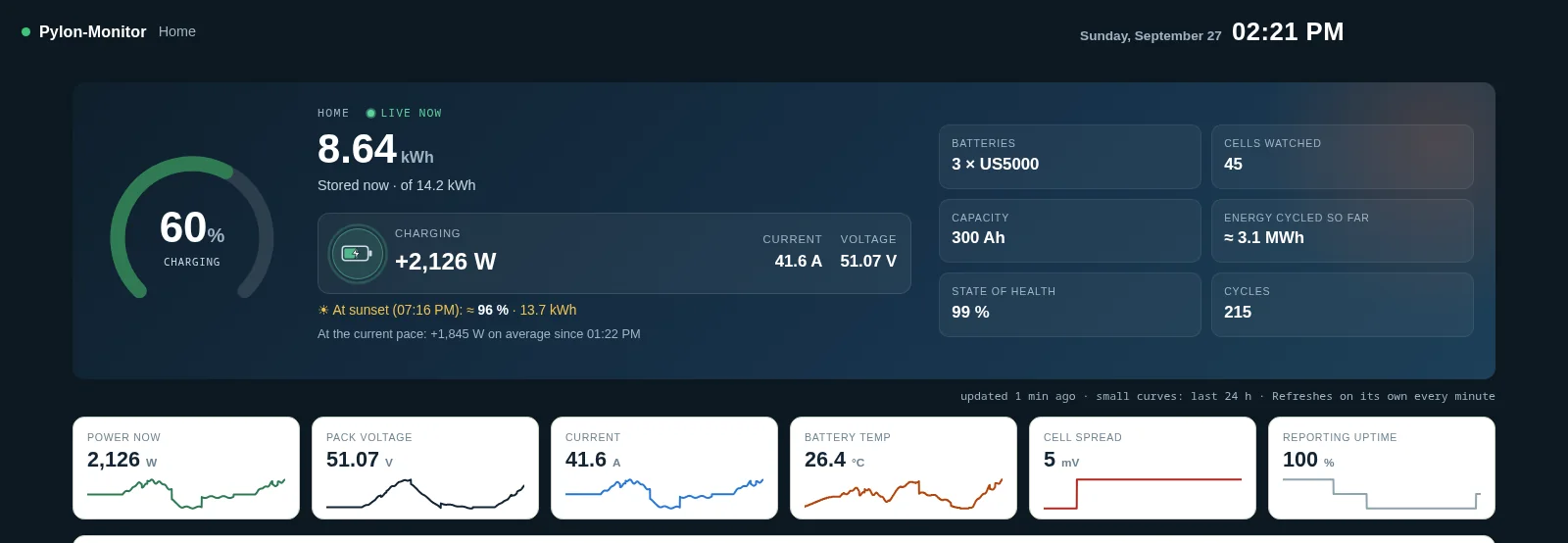
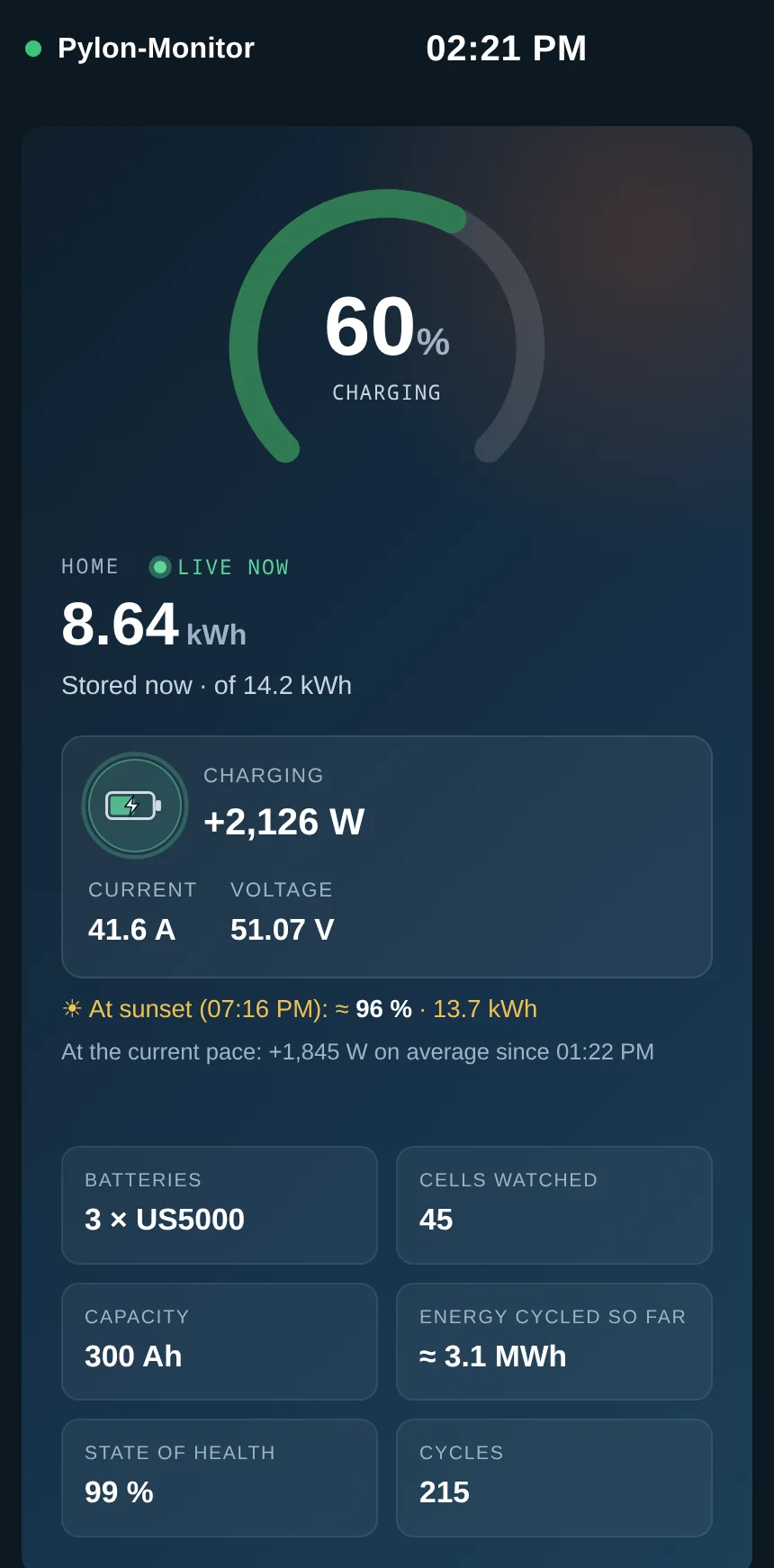
Both let you watch a Pylontech battery. Pylon-Monitor is finished and it is yours: €59, firmware v3.4.3 in production, a screen on the box, a dashboard on your own LAN, a local JSON API, MQTT auto-discovery, Home Assistant working today, and a cloud you can switch on or leave off. PylonCheck is about three times the price — 4 400 CZK — and its own comparison page marks the local dashboard, the local API, MQTT, BYOH, BMS Control and signed updates as Planned, Home Assistant as Canary — not active yet, and the product itself as “a working beta”. Those are their words, on their page, next to a price about three times ours. A screen-free Pylon-Monitor V2 Lite is also available, from €49, for anyone who does not need the on-box display.
Compared on September 7, 2026 from information published on pyloncheck.com, including their own comparison page. A competitor's product changes; if anything below is out of date, tell us and we will correct it — as we did with two rows on 7 September.
| Criterion | Pylon-Monitor | PylonCheck |
|---|---|---|
| Independence — what you actually own | ||
| Keeps working if the vendor disappears | Yes — it never needed us | No — the box is a client of their cloud |
| Where your battery data lives | On your device. Cloud is opt-in, off by default | "Customers today use the cloud view" |
| Cell balancing | Smart Balance — a guided balancing session from the dashboard, with any inverter, every cell followed live | "Force Balance" — a two-hour session |
| Can a third party act on your battery remotely? | No — impossible by design | Yes — "after approval" |
| Effect on your Pylontech warranty | None — balancing is done by your battery's own BMS, as Pylontech designed it | Their own feature writes to the BMS |
| Usable with no account and no sign-up | Yes | No |
| Runs entirely on your own network | Yes | Planned — their own status |
| Price and commitment | ||
| Device price | 59 € | ≈ €180 (4 400 CZK incl. VAT; 3 400 CZK launch offer on their first 5 units) |
| What the same LV monitoring costs you | 1× | ≈ 3× more |
| Subscription | None | None |
| Cloud history | Included, free | Included, free |
| How far back the history goes | 3 years (7 d raw, 90 d 5-min, 3 y hourly) | Not specified |
| The price you actually pay | 59 € all-in — no VAT to add | 4 400 CZK, 21% Czech VAT included |
| Warranty on the device | 2 years | 2 years |
| 14-day right of withdrawal (EU) | Yes — written into the terms | Not advertised |
| Delivery and what is in the box | Shipped from Europe, tracked, RJ45 + USB cables included | Not advertised |
| Software-only license for your own hardware (BYOH) | Not offered — hardware and firmware are one product, nothing extra to buy or configure | 500 CZK, one-time — runs on your own Raspberry Pi, notebook or Linux PC |
| Short-term rental | Not offered — one flat price, the device is yours to keep | 7 days, 990 CZK incl. VAT, plus a 4,000 CZK refundable deposit — Czech Republic and Slovakia only, 2 units available |
| Hooking it up | ||
| Battery port used | CONSOLE (RS-232) | CONSOLE (RS-232) |
| Link to your network | WiFi — no cable to run | Wired Ethernet on the standard box |
| WiFi | Built in, captive portal | "Optional WiFi", by arrangement |
| Power | Any 5 V USB source | 230 V mains adapter |
| Setup time | Under 2 minutes | Not advertised |
| What you need to install | Nothing — a browser | Not advertised |
| Who installs it | You do. Plug and play | "A controlled installation" — their words |
| Batteries supported | ||
| Low-voltage models supported | US5000 / US5000C / US5000-1C, US3000C, US3000, US2000C, US2000B+, UP2500, Force-L1 | 3 verified: US2000C, US3000C, US5000 |
| Batteries in one stack | Up to 16, mixed models allowed | Not specified |
| Compatibility claim | Any LV Pylontech with a Console port at 115200 baud | "We do not claim universal compatibility with every revision" |
| High-voltage packs (Force H2, H48050) | Yes — generation 2, firmware 2.8 (beta) | Yes |
| What you see | ||
| Screen on the device | 1.8" colour IPS TFT | None — "the standard Box has no TFT" |
| Choose what the screen shows | Yes, with a live preview | No screen to configure |
| Dashboard without internet | Yes — it lives on the device | Planned — their own status |
| Dashboard from anywhere | Yes, optional | Yes |
| Charge, voltage, current, power, temperature | Yes | Yes |
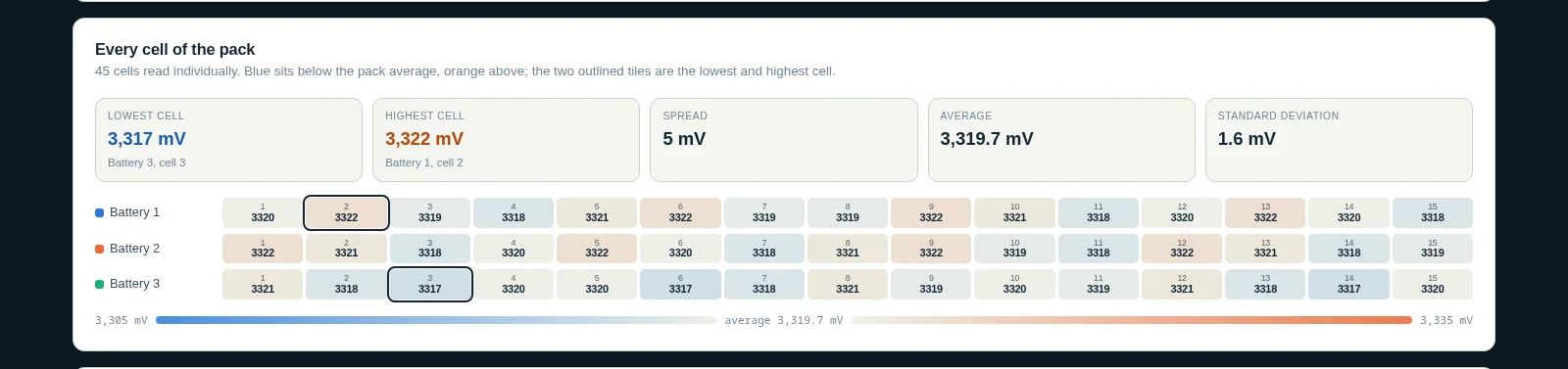
| Per-cell voltages | Yes | Yes |
| BMS alarms | Yes | Yes |
| Per-battery detail | Yes, all 16 batteries | Yes, in supported installations |
| SOH, cycles, imbalance | Yes | Yes |
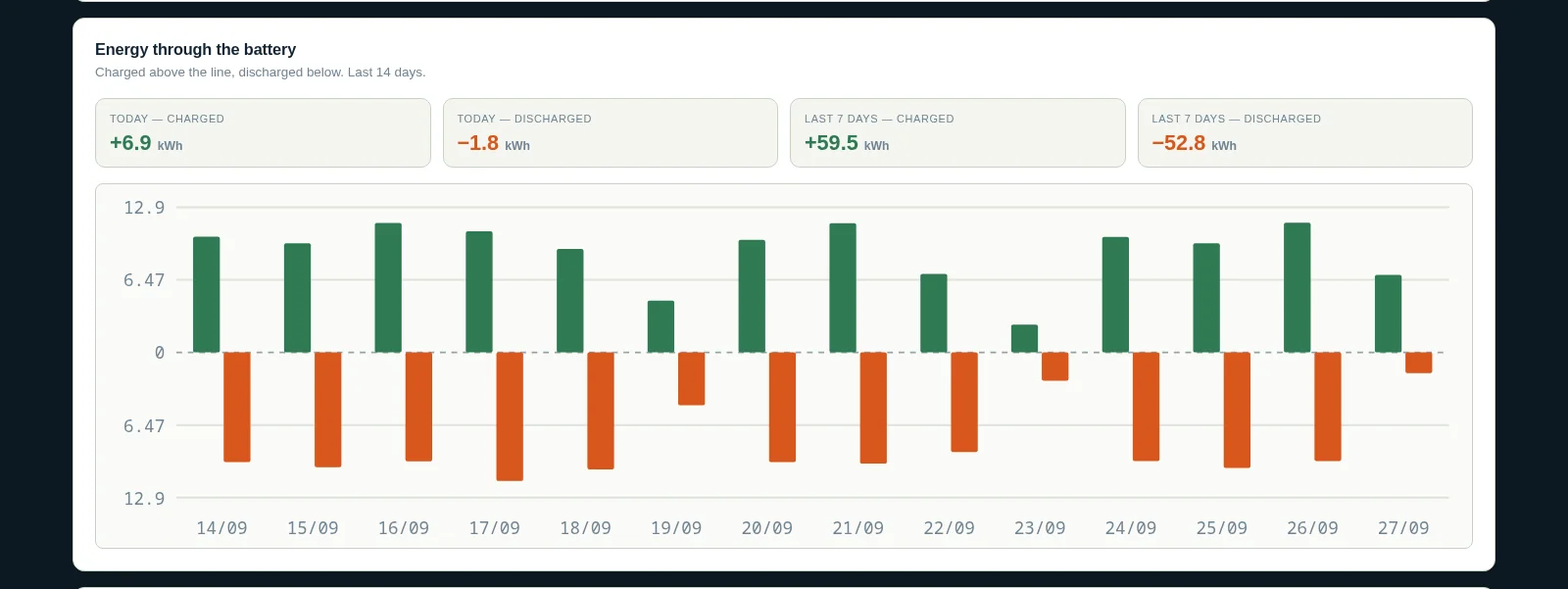
| Energy in kWh, charged and discharged per day | Yes — every day, 14 days back | Not advertised |
| Cell imbalance judged against that pack's own normal | Yes — against its own recent normal | Not advertised |
| CSV export | Yes — locally and in the cloud | Yes |
| Raw console replies, for diagnosis | Yes | Not advertised |
| Event log and boot history that survive a crash | Yes | Not advertised |
| WiFi signal history and gateway test | Yes | Not advertised |
| Live refresh rate | Every ~4 seconds | Not specified |
| Alerts | ||
| Email alert when the device goes silent | Yes — email after 6 h of silence, in your language | Not advertised |
| Push alerts to your phone | Yes — Pushover, with a test button | Not advertised |
| Your own SOC and temperature thresholds | Yes, with hysteresis | Not advertised |
| What the alerts cost | Included, free | Not advertised |
| What happens when the cells drift apart | Smart Balance: every full charge measured automatically, a balance score, the weak cell named with its serial number — and a guided 2-hour session with your inverter, followed live, with a before/after report cell by cell. | "Force Balance" — a two-hour session on the stack. "On LV it acts on the whole stack, not an individual slot; we do not claim universal support for every model." |
| Integration | ||
| Local JSON API | Yes — GET /api.json, one call, everything | Planned — their own status |
| MQTT auto-discovery | Yes — 10 sensors, zero YAML | Planned — their own status |
| Home Assistant | Working today — MQTT auto-discovery or REST | Canary — "not active yet" |
| Jeedom, Node-RED, Domoticz, openHAB | Yes — all four read the same endpoint | Not advertised |
| Your own scripts | Yes | Not advertised |
| Works with no internet at all | Yes | Planned — their own status |
| Integration documentation | Published on the site | Not advertised |
| The device itself | ||
| Hardware | Own board and firmware, assembled and tested in France | Off-the-shelf micro PC, "model varies with stock" |
| Firmware updates | Signed OTA, one click, free for life | Planned — their own status |
| Maturity of what ships today | v3.4.3, in production | "A working beta" — their words |
| Public changelog | Published on the site | Not advertised |
| Power draw | Under 0.5 W | Not advertised |
| Moving parts | None — no fan, no SD card | Not advertised |
| Locked out or moved house | 3 taps on the button — no support ticket | Not advertised |
| How hard the console port is polled | One command every 10 s, deliberately paced | Not specified |
| Service and reach | ||
| Support | 7 days a week, answered within 24 h | "Almost 24/7" — their words |
| Who answers you | The person who wrote the firmware | "A real person with hands-on experience" |
| Installer fleet view | Yes — live today | "Installer roles are not finished yet" |
| Install guide after delivery | Yes — sent automatically, in your country's language | Not advertised |
| Languages | 6 | 2 |
What PylonCheck says about PylonCheck
Not our assessment — their own status badges, on their own comparison page, on 6 September 2026. Six of the features they compare against us are not released.
Every one of those six is shipping, documented and in production on a Pylon-Monitor today, for about a third of the price.
Twenty-five reasons the answer is usually ours
- About three times cheaper€59 against roughly 180 € (4 400 CZK incl. VAT). Same job on a low-voltage Pylontech stack, and no subscription on either side.
- It is finishedFirmware v3.4.3, in production, public changelog. Their own page calls the current product “a working beta”.
- Smart Balance includedEvery full charge measured, a balance score for your pack and the weak cell named — and a guided balancing session with your inverter, followed cell by cell, with a before/after report.
- Nobody but you can reach itThere is no remote path into your battery to approve, revoke or trust. Theirs has one, opened “after approval by the PylonCheck owner”.
- It survives usIf this company vanished tonight, your screen, your dashboard, your API and your Home Assistant sensors would carry on exactly as before. A box that is a client of a cloud does not have that property.
- A screen on the boxGlance at it: charge, voltage, current, health, cycles, temperature. No phone, no login, no network. Theirs has no display at all.
- A dashboard that does not need the internetIt is served by the device itself at http://pylon-monitor.local. Router down, ISP down, us gone — you still see your battery. Their local dashboard is marked Planned.
- A real local APIGET /api.json returns the entire battery state in one call, on your LAN, with no account. Theirs: “not been released yet”.
- Home Assistant that works todayTwo supported routes — MQTT auto-discovery or REST — documented on /home-assistant. Theirs is in canary, with production tokens not active.
- Ten sensors, zero YAMLFill in your broker and ten entities appear under one device card, with an online/offline availability signal.
- Jeedom, Node-RED, Domoticz, openHABAll four read the same endpoint. So does a two-line shell script, and so will whatever you use in five years.
- Energy in kWh, not just instantaneous powerHow many kWh went in and out today, and every day for a fortnight. No single reading can answer that.
- Cell imbalance judged against its own historyNot a fixed threshold: the imbalance is compared with that pack's own 30-day normal, which is how a slow drift gets caught before it is an alarm.
- It tells you when it stops reportingA box that lost power cannot announce it. Ours is watched from our side: six hours of silence and you get an email, in your language, with what to check first.
- Push alerts on your own thresholdsYour SOC and temperature limits, with hysteresis so one noisy reading cannot spam you, straight to your phone via Pushover — and a test button to prove it works.
- Three years of history, includedEvery push kept raw for 7 days, averaged to 5-minute samples for 90 days and hourly for 3 years. No subscription, no tier, no upsell.
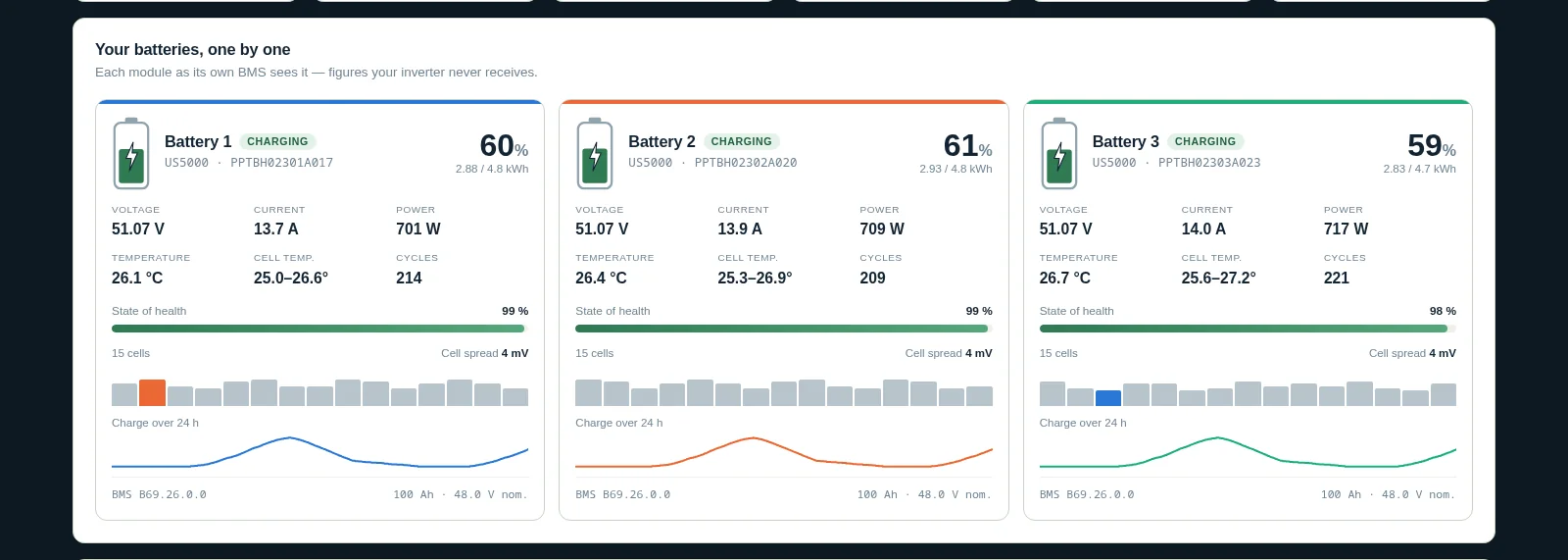
- Up to sixteen batteries, models mixedSixteen US5000 (≈76.8 kWh), sixteen US2000, or any mix — each one reported individually, with a selector to switch between the whole stack and any single battery.
- Purpose-built hardwareOur own board, our own firmware, assembled and tested in France. Theirs is an off-the-shelf micro PC whose “model varies with stock”.
- Signed updates, free for lifeEvery published image is HMAC-signed and the device refuses anything altered. One click, thirty seconds, settings preserved. Their signed-update system is marked Planned.
- Under half a watt, from any USB portA phone charger, a spare port on your inverter, a power bank. Theirs ships with a 230 V mains adapter.
- Two minutes, no app, no installerCaptive portal: connect your phone to the box, pick your WiFi, done. No app to install, no command line, no “controlled installation”.
- Locked out? Three taps.Three quick presses on the reset button wipe the settings and reopen setup, where you create a new password. No ticket, no waiting, no remote session into your home.
- A fleet view for installers, todayEvery customer site on one screen, worst first. Their delegated installer roles are “not finished yet”.
- Support seven days a weekAnswered within 24 hours by the person who wrote the firmware — not a queue, not a bot, and not a session that needs access to your battery.
- Six languages, and the paperwork to matchSite, firmware, guides and support in English, French, German, Dutch, Spanish and Italian; 2-year warranty; 14-day EU right of withdrawal written into the terms; shipped from Europe with both cables in the box.
Ready to decide?
One device, one price, no subscription, and everything above included — shipping today, not planned.
Order now — €59One-time purchase, €59 total — no VAT, no subscription.
Source for the PylonCheck column: pyloncheck.com, consulted September 7, 2026. Quoted phrases are theirs.