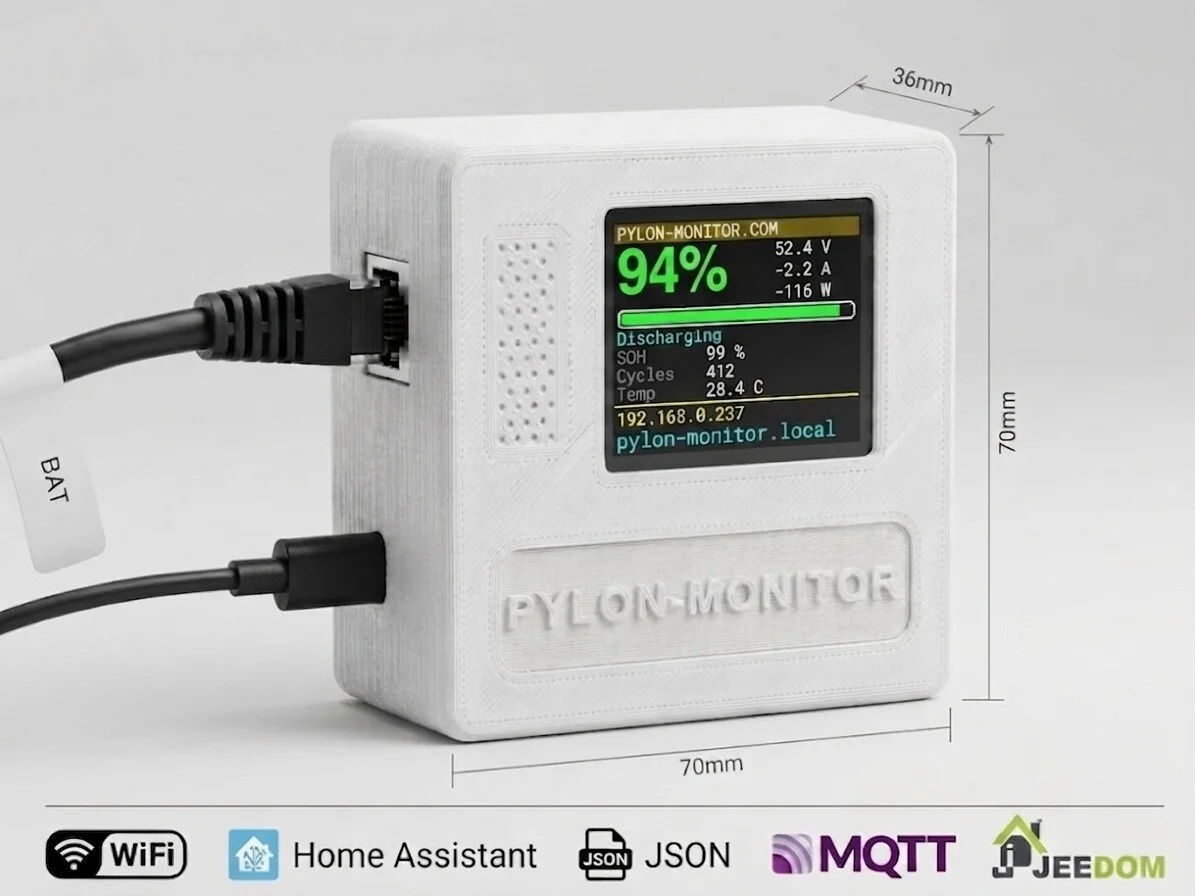
A dedicated device that reads State of Charge, voltage, cell health and temperatures straight from your Pylontech US5000, US3000C or US2000 — and exposes it all through a clean JSON API for Home Assistant, Jeedom, Node-RED and more. Truly plug & play: one cable, one USB, one captive WiFi portal — under 2 minutes from box to live dashboard. No app, no account, no cloud, no command line.
Pylon-Monitor Lite
No screen · same firmware
€39
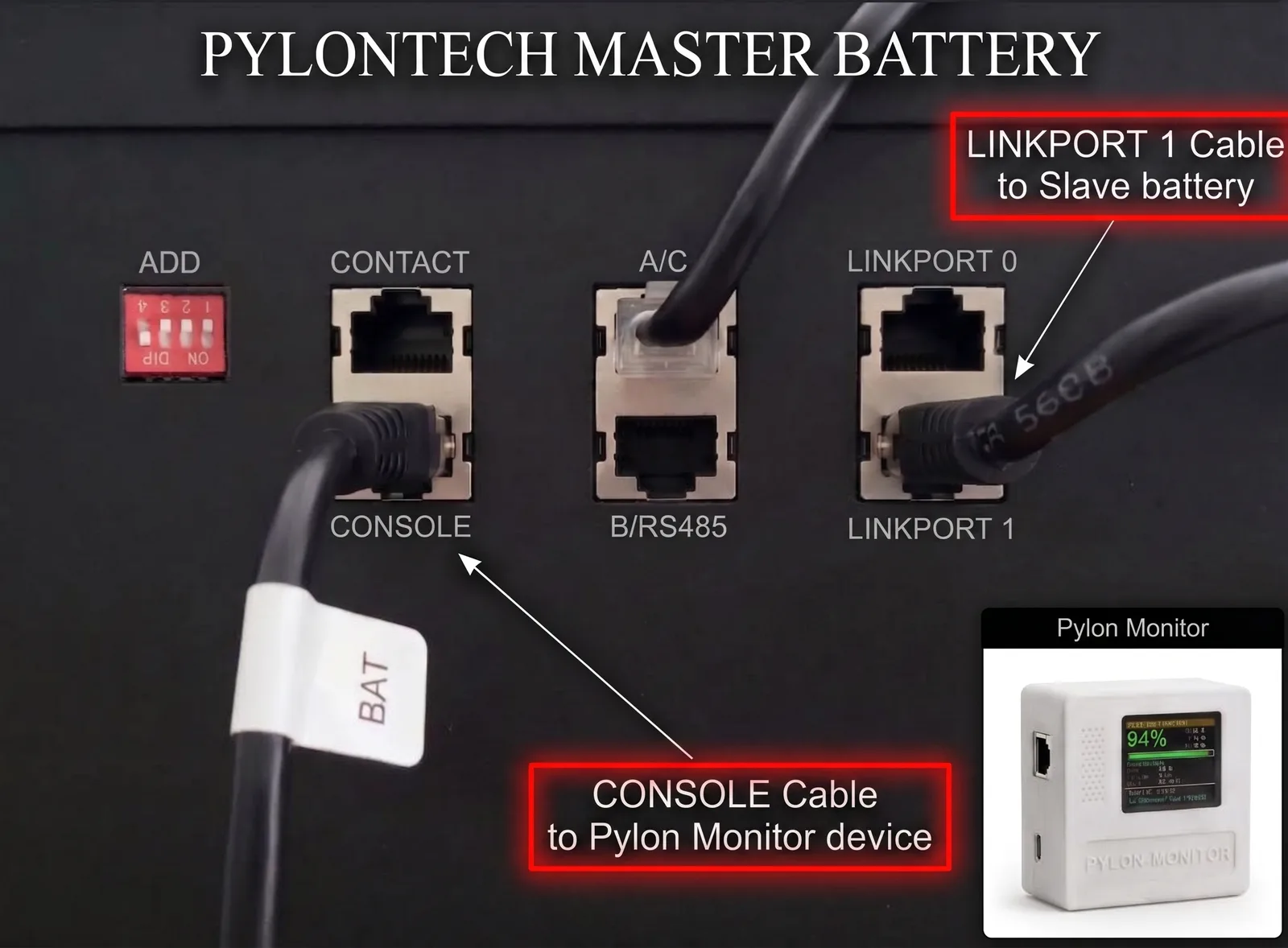
Plug it into the battery's Console port, power it over USB, join your WiFi. From that moment you read state of charge, voltage, current, temperature, cell balance and BMS alarms — on the box's own screen, on your phone, in Home Assistant, and in your online dashboard the moment you switch it on. Here the cloud is a feature, not a dependency: turn it off and everything else carries on.
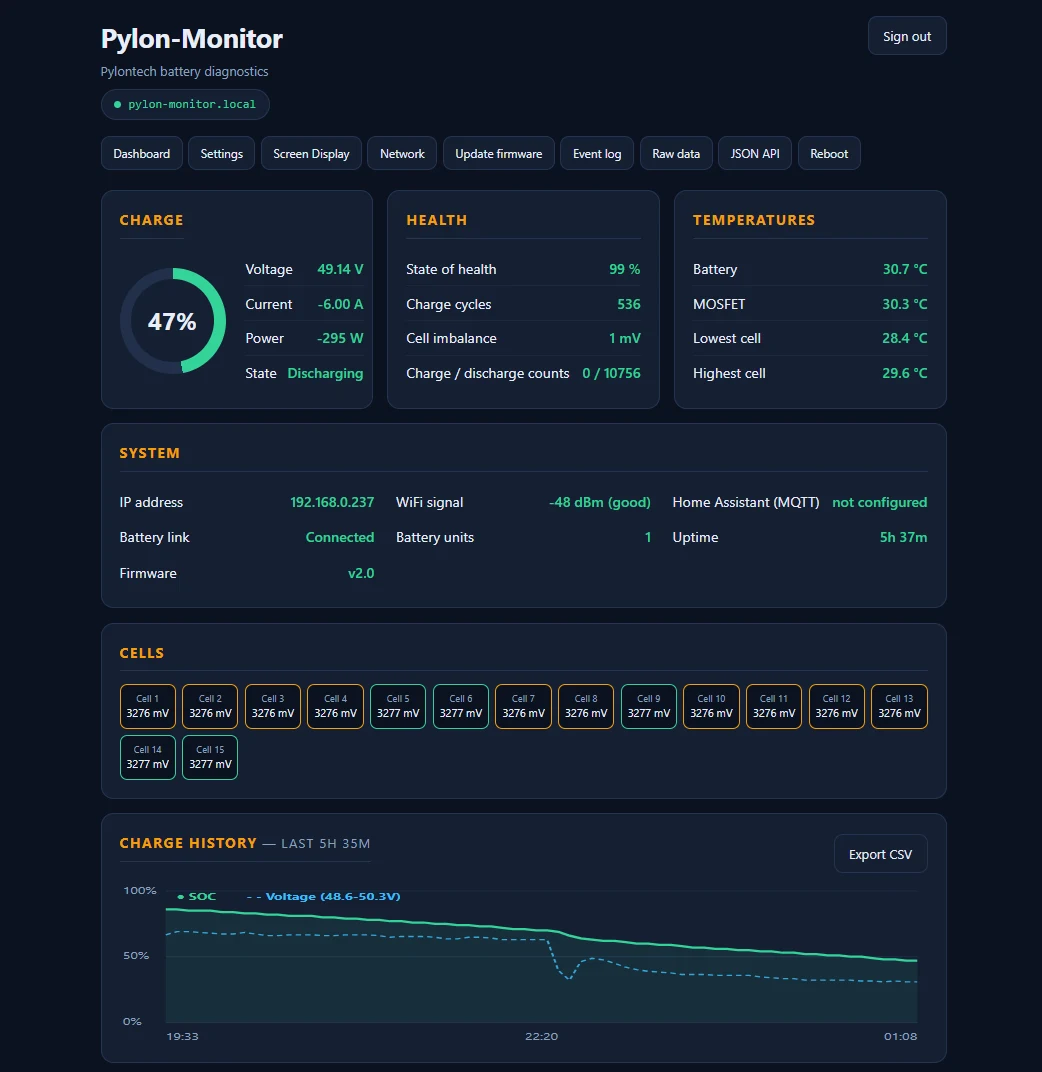
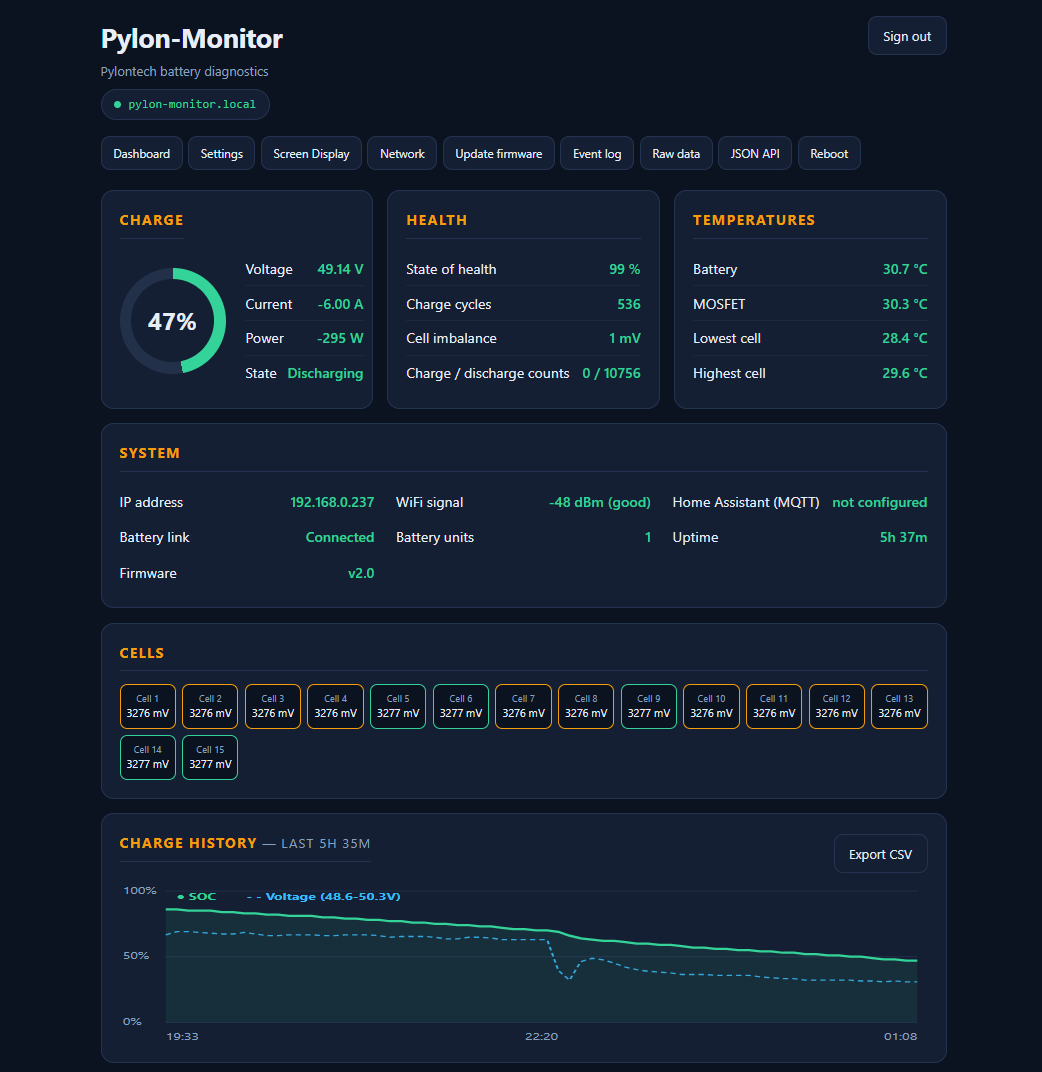
Charge, health, temperatures and cells at a glance
Pylon-Monitor isn't a rebranded factory board. Our engineering team writes the firmware, assembles the PCB, engineers the enclosure around its 1.8" IPS TFT, and quality-tests every single unit before it ships.
The WiFi captive portal, the web dashboard and the JSON API are all custom firmware that our engineering team writes and maintains in-house.
Every board is wired, soldered and inspected — then flashed and function-tested before it goes in its case.
Engineered in-house around the 1.8" IPS TFT, refined over several design revisions for a snug fit and proper heat venting.
Designed for solar installers, off-grid enthusiasts and home automation users.
Zero-YAML MQTT auto-discovery — 10 sensors appear automatically. Prefer REST? A clean JSON API at /api.json gives you a short, auto-generated YAML paste instead.
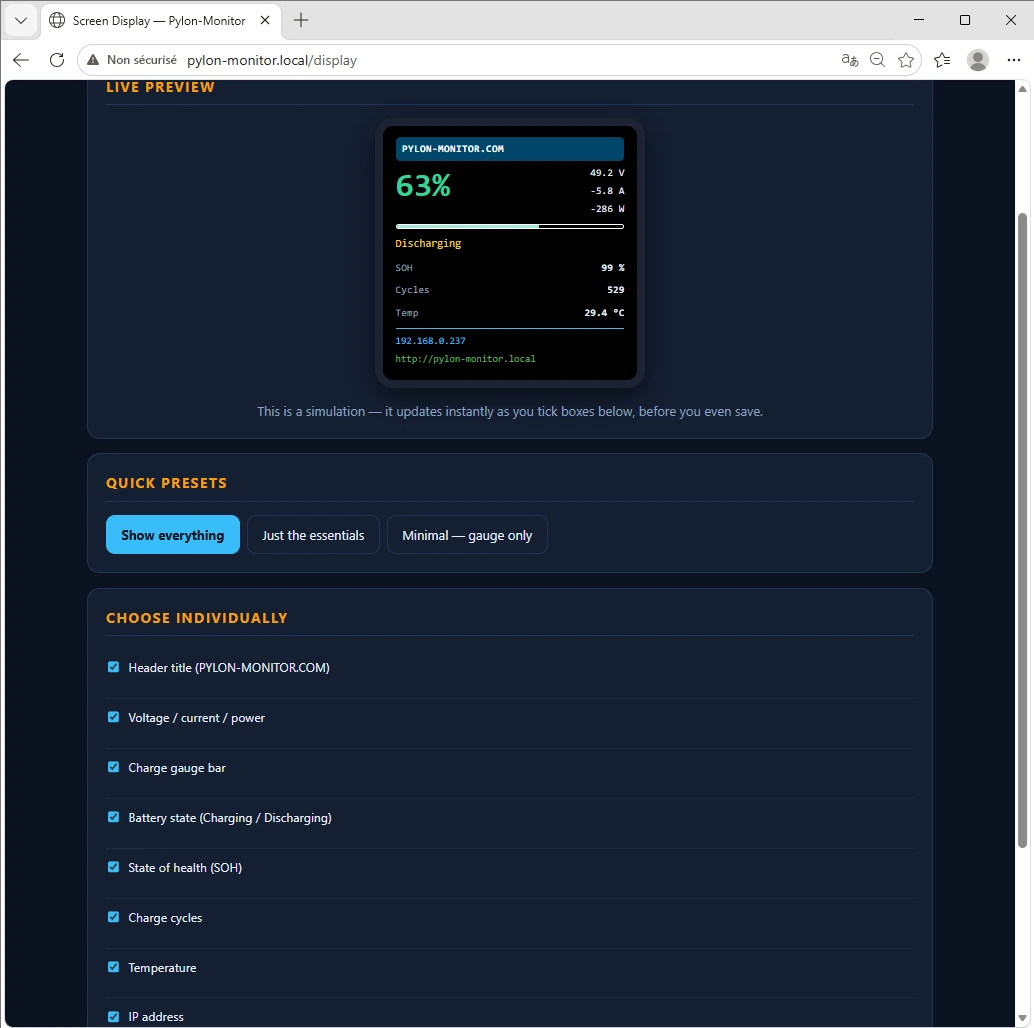
Glance at the box and instantly read State of Charge, voltage, current, SOH and cycle count.
Open http://pylon-monitor.local from any phone or PC on your WiFi. No app, no account.
On first boot the box creates its own WiFi network. Connect, pick yours, type the password — done.
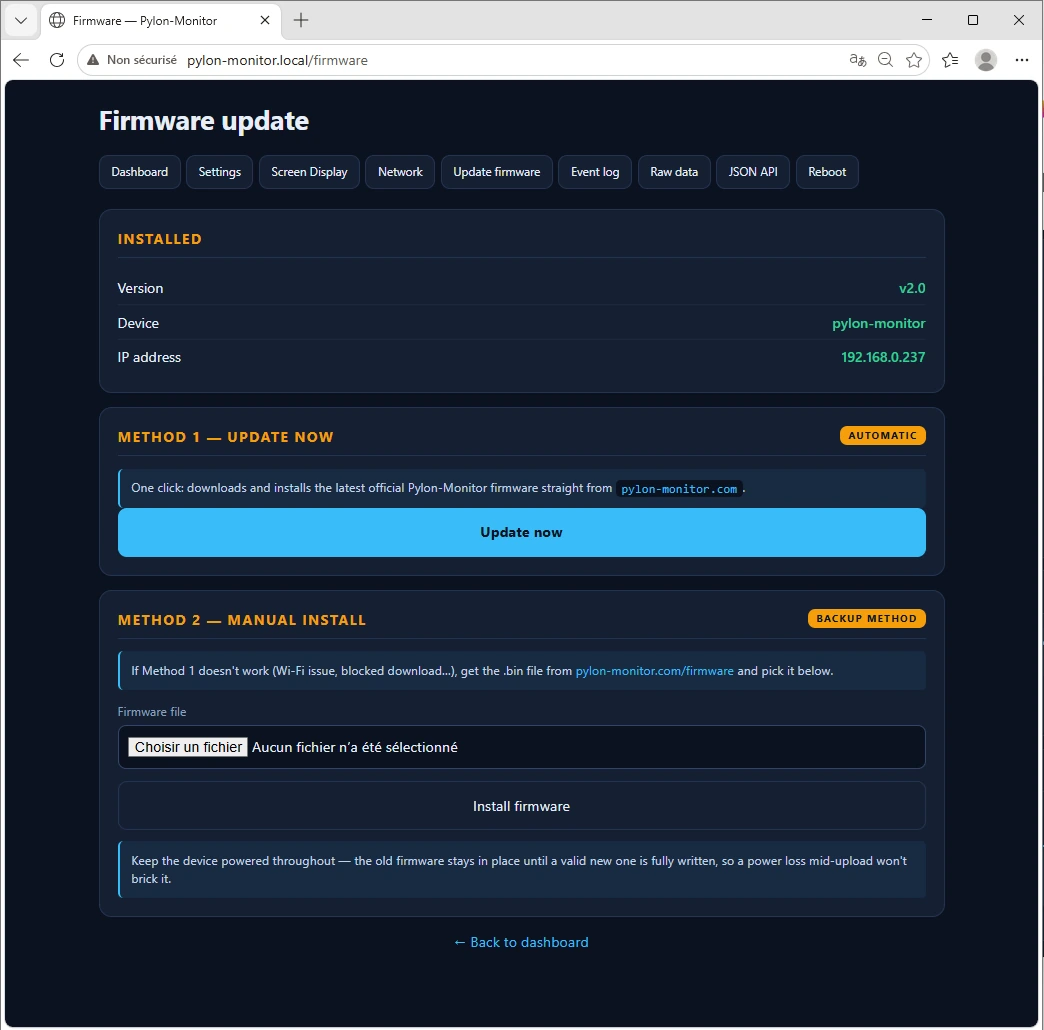
New features arrive through a friendly web update page. No cables, no soldering, no skills required.
Your battery data stays on your network by default — no cloud, no telemetry, no subscription, unless you turn on the optional public link below.
Flip on a private link in Settings and pylon-monitor.com relays your JSON to a URL that works from your phone, the office, on the road — no port forwarding, no VPN. Off by default; turn it back off and the pushes stop immediately.
Works with the Console (RS-232) port on every Pylontech family: the low-voltage US series, and high-voltage Force H2 / H48050 towers on the current hardware generation.
Not sure if your model is compatible? Check the FAQ or contact us.
Connect the included RJ45 cable from the Pylon-Monitor to your battery's Console port. Power it with any USB cable.
Open WiFi on your phone, pick PylonMonitor-Setup, then choose your home network and enter its password.
The TFT screen shows the device IP. Type it in your browser — your battery's live data appears instantly.

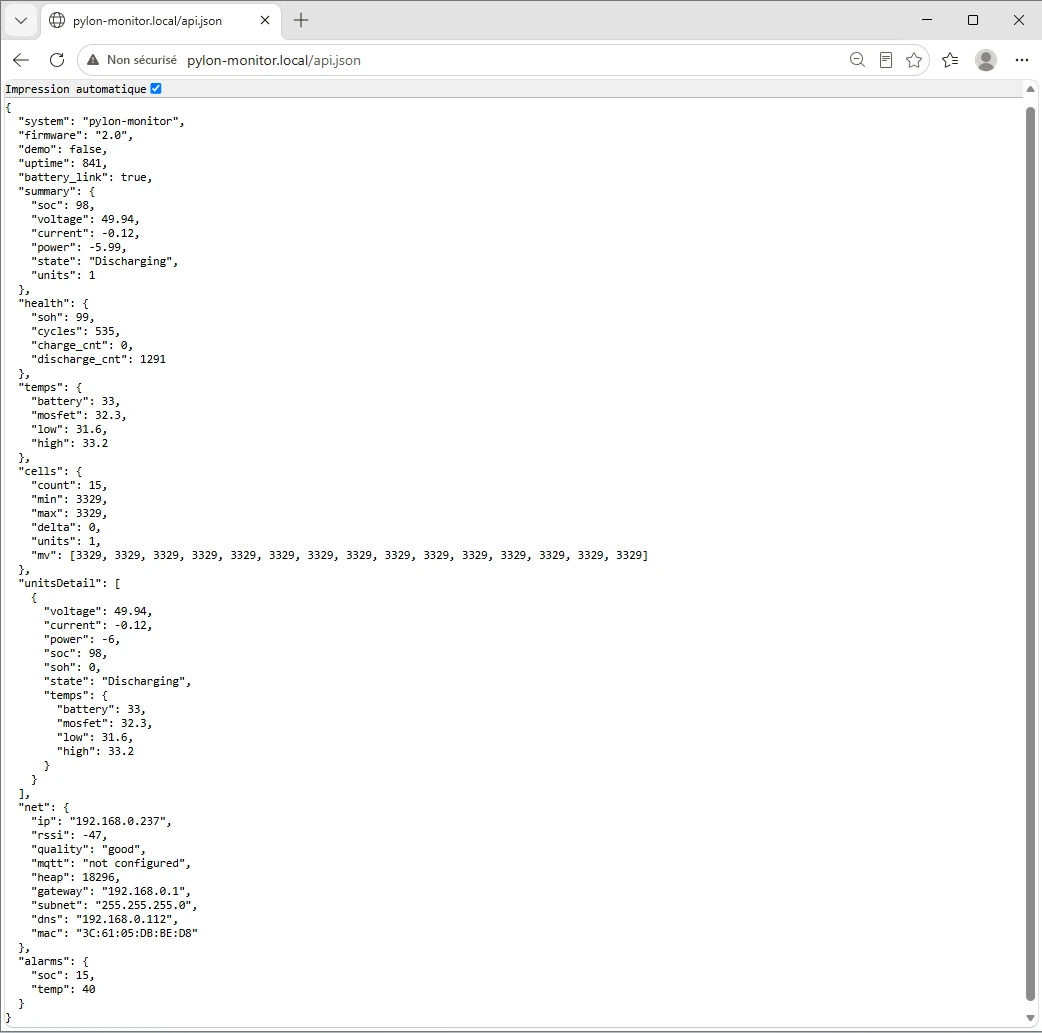
One HTTP call returns SOC, SOH, voltage, current, power and state — ready to plug into your favourite home automation tool.
/api.jsonrest sensor supportGET http://<DEVICE-IP>/api.json
{
"system": "pylon-monitor",
"firmware": "2.2",
"summary": {
"soc": 94,
"voltage": 48.62,
"current": -7.20,
"power": -350.10,
"state": "Discharging"
},
"health": {
"soh": 96,
"cycles": 486
}
}
Every screen below is an actual screenshot from a running device.
8 customer reviews, 5 out of 5 on average.
Excellent rapport qualité/prix à 49 €. J'avais un peu d'appréhension pour l'intégration sur mon parc de 3 batteries US2000C, mais le portail WiFi captif rend la configuration enfantine, littéralement pliée en 2 minutes. Le fait de pouvoir interroger l'API JSON entièrement en local me rassure sur la pérennité du système. L'écran TFT est un vrai bonus pour le diagnostic rapide au garage. Je recommande !
I chained four US3000C batteries and this reads the master and all slaves effortlessly. I used to rely on a clunky DIY Raspberry Pi setup with cables everywhere, but this neat little box is so much cleaner and way more stable. MQTT auto-discovery worked flawlessly. Fantastic piece of hardware for the price, especially with the built-in screen.
Plug and play at its best. Setup took exactly two minutes as advertised and it pulled my US5000 data right away. Love the local approach.
Einfach und lokal. Keine Cloud, kein Abo. Genau das, was ich für mein Home Assistant Setup gesucht habe.
Muy buen producto. Fácil de usar y cero problemas con MQTT.
Vraiment top. Reconnu instantanément dans Jeedom.
Impeccable.
Works perfectly!
Same WiFi monitoring, same dashboard, same JSON API — with or without the screen. No subscriptions, ever.
Ships from Europe · Tracked delivery · Secure payment
Yes. The device is 100% local. It only needs your WiFi to be accessible from your phone or your Home Assistant instance.
No. The Console port is read-only and meant for monitoring. The Pylon-Monitor never sends commands that change battery behavior.
Yes — up to 16 batteries in total, chained together. For example: 16× US5000 (≈76.8 kWh), or a mix like 2× US2000 + 2× US3000 + 1× US5000. Plug into the master's Console port only and the Pylon-Monitor queries every physical battery individually, with a per-battery selector on the dashboard. Only the per-cell voltage detail (a technical reading) is limited to the first ~4 batteries — everything else works for all 16.
Download the free .bin file from our firmware page, open the dashboard, click Update firmware, and upload it — done in under 30 seconds, settings preserved.
The Pylon-Monitor plugs into the Console port with the included RJ45 cable and gives you a WiFi dashboard reachable from any phone, tablet or PC on your network — no USB cable permanently tied to a computer. At €59 with lifetime firmware updates and no subscription, it typically costs a fraction of wireless Pylontech diagnostic adapters on the market.