Compatibility
Which Pylontech batteries are supported?
Both Pylontech families, low voltage and high voltage. Low voltage: US5000 (also sold as US5000C / US5000-1C), US3000C, US3000, US2000C, US2000B+, UP2500 and the Force-L1 family — every unit reads those. High voltage: Force H2 towers and H48050 modules behind a management unit, since firmware 2.8 and on the hardware generation shipped with orders placed from 5 September 2026. In both cases the connection is the same: the "Console" RJ45 port, RS-232, 115200 baud. If your battery has one, it works.
Does it work with high-voltage Pylontech (Force-H, H48050)?
Yes, since firmware 2.8 — on the new hardware generation, which every unit ordered from 5 September 2026 carries. A high-voltage pack does not answer like a low-voltage one: its management unit reports the whole tower in a single reply and returns every cell of the pack at once. The firmware recognises that from the first reply and switches to the right questions on its own, with nothing to configure. Charge, voltage, current, temperatures, every module and every cell then appear exactly where they always do. Two limits we would rather state than let you discover: your management unit reports no state of health and no cycle count, so those two lines show a dash instead of an invented figure; and no real high-voltage pack has been connected to a Pylon-Monitor yet — this support was written from real console readings of two different management-unit firmwares. If yours answers differently, the device has a discovery page that collects what it says, and we extend it from there. Units shipped before 5 September 2026 read the low-voltage US series only.
Will it work with my BYD / Dyness / Seplos / other brand battery?
No. The Pylon-Monitor speaks the Pylontech console protocol. Other brands use different protocols (often Modbus or CAN) and are not compatible.
Can I monitor multiple stacked batteries? How many at most?
Yes — up to 16 batteries in total, on a single Pylon-Monitor. For example: 16× US5000 (≈76.8 kWh combined), 16× US2000 (≈38.4 kWh combined), or any mix such as 2× US2000 + 2× US3000 + 1× US5000 chained together. Plug the RJ45 cable into the Console port of the master battery only (never a slave unit, and never the RS485/CAN/Link port) — the master relays the query to every unit in the chain over their internal link. Pylon-Monitor detects and shows each physical battery individually (SOC, voltage, current, power, state, SOH, cycles, temperatures), all 16 if you have that many. The only thing capped beyond roughly the first 4 batteries is the per-cell voltage detail on the Cells card (a technical reading most people never look at) — every other number keeps working normally for all 16. One catch: the batteries themselves must be chained correctly — the link cable leaves LINK PORT 1 on the master and goes into LINK PORT 0 on the next one, then 1 → 0 again for each battery after that. Chained wrongly, the master has nothing to relay and you will only ever see one battery.
Monitoring, viewing & checking
How do I view my Pylontech battery data?
Four different things get called a Pylontech viewer, and each shows a different slice of the data: Pylontech's own PYLON Console software on a laptop, your inverter's screen or app, a permanent web dashboard on your network, or your own display built on a JSON API. We compare all four, including when the free laptop route is the right answer, in the Pylontech viewer guide.
How do I check whether my Pylontech battery is healthy?
Eight readings are worth verifying: SOC, SOH, pack voltage, current, per-cell voltages, the cell-imbalance trend, temperatures, and alarm flags plus cycle count. The front-panel LEDs give you a five-second liveness check but say nothing about health. The full Pylontech check checklist is here, and what each number actually means is here.
Is “Pylontech check” the same thing as PylonCheck?
No — and search results confuse them constantly. A Pylontech check is the procedure of inspecting your battery's readings, with any tool you like. PylonCheck is a specific commercial product from Daxit s.r.o., a cloud-based monitoring box. Our point-by-point comparison covers it honestly, including the two areas where it does more than we do.
Can I see per-cell voltages and per-module SOH?
Yes, because the Pylon-Monitor reads the Console (RS-232) port. Your inverter cannot show you these: it uses the CAN or RS485 link, a control protocol that deliberately describes the whole stack as one virtual battery, so per-module SOH, individual cell voltages and per-module temperatures are never sent over it at all.
Installation
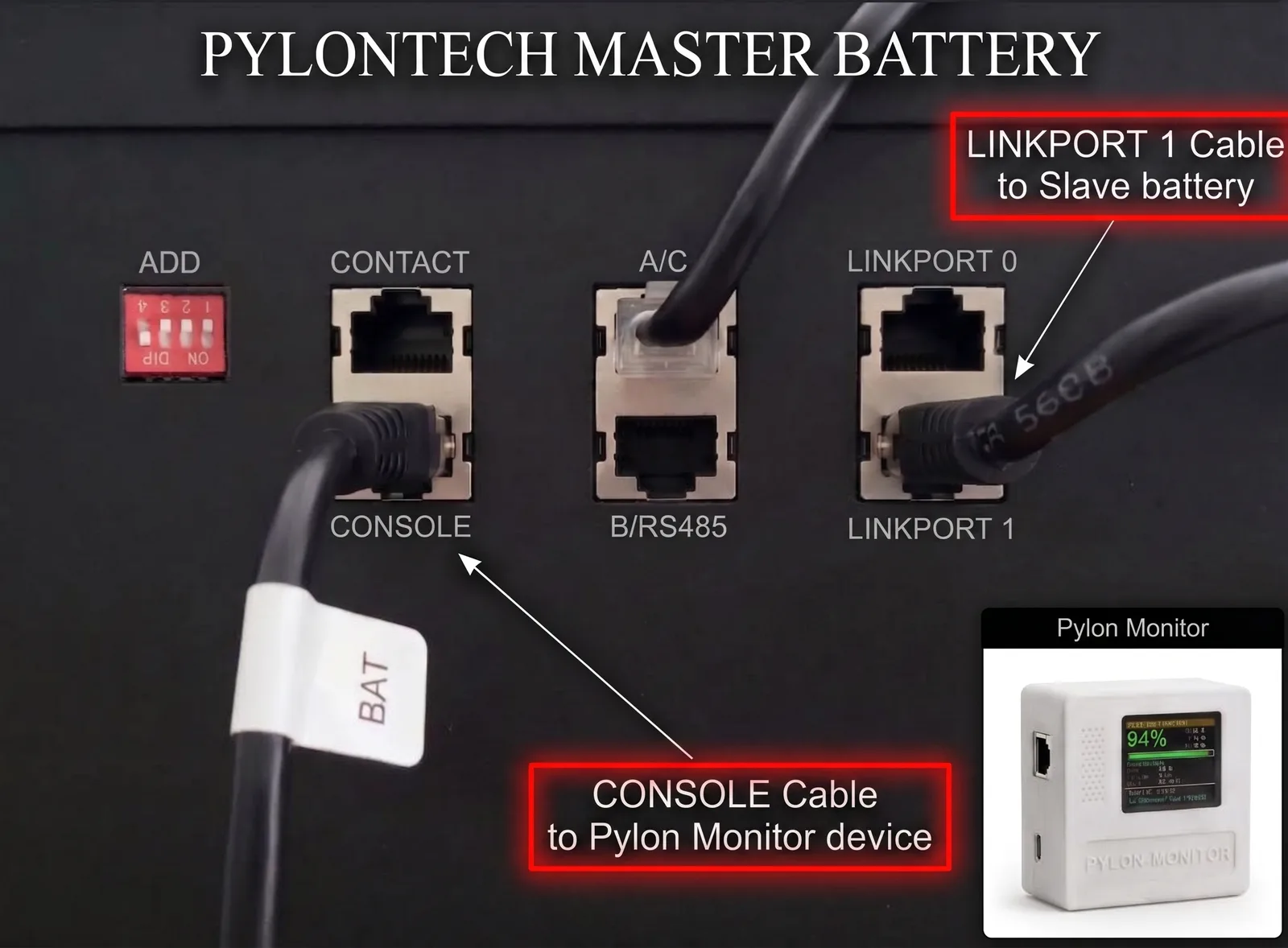
The cable that chains your master battery to the first slave must leave LINK PORT 1 on the master — never LINK PORT 0. It plugs into LINK PORT 0 on the slave, and every further battery repeats the same 1 → 0 pattern. Wired the other way round the master never sees the rest of the stack, so Pylon-Monitor reports a single battery no matter how many you own.
Do I need to build this myself — a Raspberry Pi, a microcontroller, flashing firmware?
No. Pylon-Monitor ships as a finished, fully assembled device — there is nothing to build, solder or flash. Plug the included RJ45 cable into the battery's Console port, plug in the included USB cable for power, join the device's WiFi setup portal, and you are done in under 2 minutes. Some unrelated open-source projects with similar-sounding names ask you to buy your own hardware and flash your own code; that is not what this product is.
Which RJ45 port should I use?
The one labeled Console. Not RS485, not CAN, not Link. Look for the small "Console" silkscreen near the port on the top of the battery.
Will it interfere with my inverter?
No. The inverter typically talks to the battery on the CAN or RS485 port. The Console port is a separate, independent interface designed for monitoring and diagnostics.
Does it need a special cable?
No. Any standard straight-through Ethernet RJ45 cable works. One is included in the box.
How much does the package weigh?
The device alone is 79 g; the RJ45 console cable and USB-C power cable together add 14 g, for a 93 g net weight. With packaging, the parcel that ships is about 123 g.
How do I power it?
Any 5V USB source. A phone charger, a USB port on your inverter, a power bank, a Raspberry Pi… The device draws under 0.5 W.
Where does the LINK PORT cable go — and why does it matter?
The cable that chains your master battery to the first slave must leave LINK PORT 1 on the master — not LINK PORT 0, which is what most people assume. It plugs into LINK PORT 0 on the slave, and every further battery repeats the same 1 → 0 pattern. Wired the other way round the master never sees the rest of the stack, so Pylon-Monitor reports a single battery no matter how many you own. The Pylon-Monitor itself always goes into CONSOLE on the master — see the photo above.
Warranty & safety
Will it void my Pylontech warranty?
No. The Console port is read-only in the way the Pylon-Monitor uses it. We send only standard diagnostic commands (pwr, info, bat, stat) — the same ones Pylontech's own console tool sends. We never change settings, never trigger calibration, never write configuration.
Is it electrically safe?
Yes. The Console port operates at standard RS-232 voltages (±12 V) and the Pylon-Monitor uses a galvanically rated transceiver. The USB power supply is fully separated from the battery's high-voltage side.
Network & security
Does it need an internet connection?
No. The device is 100% local. It only needs your WiFi so that you (or Home Assistant) can reach it.
Do I need a VPN, Cloudflare Tunnel, or Home Assistant to check it remotely?
No — none of those are required. Remote access is a single checkbox built into the device itself: Settings → Public JSON access publishes your readings to a private, key-protected link at pylon-monitor.com, with no VPN, no Cloudflare Tunnel, no port forwarding, no dynamic DNS, and no need to install Home Assistant. By default the device runs entirely standalone on your local network, and this optional remote view stays off until you switch it on yourself. Home Assistant is a separate, entirely optional integration for automations — not a requirement to see your data from outside your home.
Does it phone home?
No. No telemetry, no analytics, no cloud. The only outbound connection the device ever makes is when you trigger an OTA firmware check.
Is the dashboard password-protected?
Not by default — anyone on your network can open it with zero friction, no login screen. If the device is ever reachable beyond your LAN, tick one box in Settings → Sign-in to require a username and password (yours to set).
I enabled a password and forgot it — am I locked out?
No. 3 quick taps in a row on the reset button (on the back of the enclosure) — each within 8 seconds of the last, nothing to hold down. It wipes all settings (WiFi, MQTT, alarms, sign-in) and restores the username/password to admin / admin with sign-in off — no old password needed, no support ticket required. See the installation guide for the full reset-levels breakdown.
Integration
Home Assistant?
Yes, two ways: zero-YAML MQTT auto-discovery (10 sensors), or a short YAML paste — auto-generated by the device — for the built-in rest platform. See the integration guide.
Node-RED / Jeedom / Domoticz / openHAB?
Any tool that can poll an HTTP endpoint and parse JSON works. The endpoint is http://<device-ip>/api.json.
Can I push data to InfluxDB / Prometheus?
Indirectly, yes — use any tool that can scrape an HTTP/JSON endpoint (Telegraf inputs.http, a small Python exporter, a Node-RED flow…) to forward /api.json to your time-series database.
Updates & support
How do I update the firmware?
Open the dashboard → Update firmware. Click Update now and the device fetches the latest version itself — or select a .bin downloaded from our firmware page and upload it manually. Either way the device reboots into the new version in about 20–30 seconds.
Are firmware updates really free for life?
Yes. We make money selling devices, not subscriptions.
I have a question that isn't here.
Email us at [email protected]. We answer.