BOV, CVL, charge voltage: three numbers that are often confused
| Name | Where it lives | What it does |
|---|---|---|
| BOV (battery over-voltage) | Inside the BMS | A protection threshold: the voltage at which the BMS considers a cell or the module over-charged and stops the charge. It is a safety limit, not a target. |
| Requested charge voltage (CVL) | Sent by the master battery to the inverter over CAN or RS485 | The voltage the battery asks the inverter to charge up to. On a Pylontech US stack it is 53.2 V. |
| Inverter charge settings | In the inverter | What the inverter actually does: it may follow the battery's request, cap it with its own limit, or stop at a maximum state of charge you set. |
"Lowering the BOV" means changing a protection parameter inside the battery. "Charging less high" can be done entirely with the third line — and that difference matters for your warranty, as we will see.
What the numbers mean, cell by cell
A Pylontech US module is fifteen lithium iron phosphate (LFP) cells in series, so every pack voltage divides by fifteen:
| Pack voltage | Per cell | Where it comes from |
|---|---|---|
| 53.5 V | 3.57 V | Top of the charge voltage range in Pylontech's US5000 manual (52.5–53.5 V) |
| 53.2 V | 3.55 V | What the battery requests from the inverter over CAN |
| 52.5 V | 3.50 V | Bottom of Pylontech's range — and the most a charger should apply without communication with the battery |
| 52.4 V | 3.49 V | The cap Victron applies in its official Pylontech integration |
| 52.0 V | 3.47 V | Victron's absorption voltage for Pylontech |
| 51.0 V | 3.40 V | Victron's float voltage for Pylontech |
Victron's documentation explains its choice plainly: 53.2 V is 3.55 V per cell, "very highly charged", and it makes the system prone to going over-voltage. One of the largest inverter makers runs Pylontech batteries a little below what the battery itself asks for — that is the most solid public reference there is on this subject.
Why charging less high is gentler
LFP is a robust chemistry, but like every lithium cell it ages two ways: with use (cycles) and with time (calendar ageing). Calendar ageing is faster when the cell spends long hours at a high state of charge, and faster still when it is warm. A pack that reaches 100 % at noon and sits there until sunset, all summer, spends a lot of time in exactly those conditions.
The top of the charge is also where trouble starts. Between 20 and 90 % the voltage of an LFP cell barely moves; in the last few percent it climbs steeply, and a cell that is slightly ahead of the others climbs first. That is when over-voltage alarms and charge-current cuts appear.
How many years does a lower ceiling add? Nobody can honestly put a number on it for your battery: it depends on temperature, how deep you cycle, and how long the pack would otherwise stay full. Be wary of anyone promising a percentage.
The catch nobody mentions: balancing happens at the top
A Pylontech BMS balances its cells in one place only — at the very top of the charge, by bleeding the highest cells while the lowest catch up. Take away the top and you take away the balancing. On a pack capped at 90 % for months, the cells slowly drift apart; the day it does go to 100 % — a sunny week, a winter grid charge — one cell runs ahead, the BMS cuts the charge early or raises an over-voltage alarm, and the usable capacity seems to have shrunk. A lower ceiling without a plan for balancing trades one problem for another.
That is exactly the gap Smart Balance and Force Balance fill. Smart Balance watches every full-charge window, and switches to balance recommended when the pack has not been fully charged for more than two weeks. Force Balance then runs the session: the pack goes to 100 %, is held there for two hours so the BMS finishes the job, and you get a before/after report cell by cell.
Two ways to lower the ceiling
| Reprogramming the BMS (lowering the BOV) | Using the inverter's settings | |
|---|---|---|
| What changes | Protection thresholds inside the battery, saved in its memory | The inverter's charge voltage limit or maximum state of charge |
| Warranty | Pylontech excludes "any attempt to extend or reduce the life of the product without written confirmation from Pylontech, whether by physical means, programming or others" | Uses settings your inverter and its official Pylontech integration provide |
| Reversible | Only by reprogramming again — and the next installer may not know it was changed | Yes, one menu, any time |
| Protection | The safety limit itself has been moved | The BMS keeps all its original protections |
| Balancing | Reaching the top becomes harder, permanently | Lift the cap whenever a full charge is needed |
We recommend the second, always. It does the same job without touching anything inside the battery, and it can be undone in a minute — including for the full charges that keep the cells together.
A practical plan
- Find your inverter's lever. Depending on the model it is a charge voltage limit (Victron, for example, lets you limit the charge voltage in its DVCC settings), or a maximum state of charge for daily cycling. With a closed-loop CAN link, many inverters follow the battery's requested voltage and ignore a manual one — then the state-of-charge cap is the lever. Your installer knows which one your model exposes; our inverter link guide explains the CAN and RS485 side.
- Choose an everyday ceiling — many owners use 90 to 95 %, or a charge voltage within the range of their inverter's Pylontech integration. Stay inside what Pylontech and your inverter maker document.
- Let Smart Balance watch. When it shows balance recommended, lift the cap for a day and start a Force Balance. For most capped packs that means about once a month.
- Check the top of the charge. On the dashboard's cell map, the highest cell at full charge and the spread tell you whether the pack arrives at the top together.
- Mind the season and the use. In winter the sun rarely fills the pack anyway; off-grid systems that need every kilowatt-hour should not be capped at all.
What to watch on Pylon-Monitor
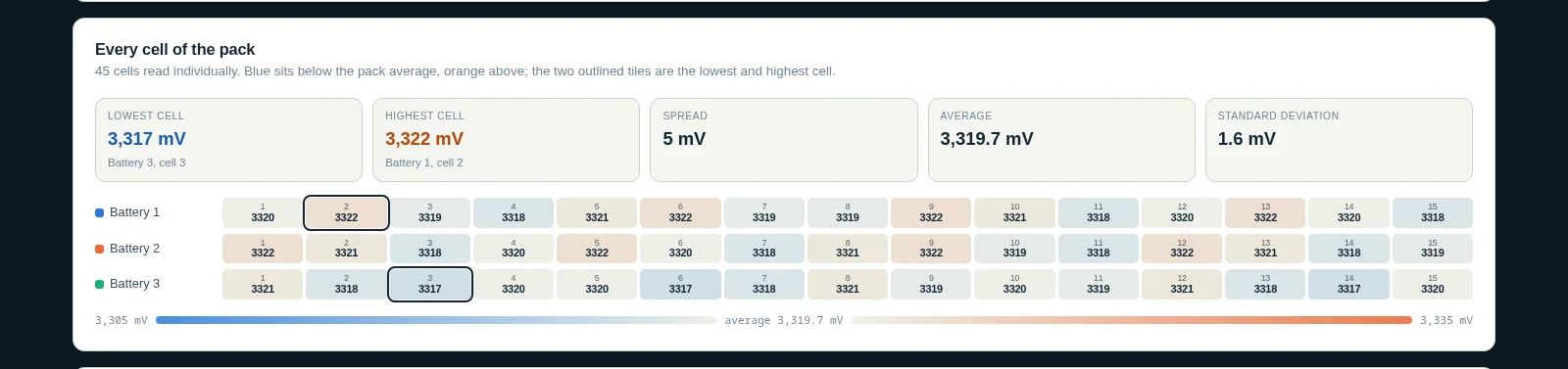
- The highest cell at full charge, and which battery it belongs to — if it is always the same one, that cell is running ahead.
- The spread at full charge against Pylontech's 30 mV target, and its 30-day trend in Smart Balance.
- Temperatures of every battery: a warm battery room ages cells faster than any voltage setting.
- The state of charge over the day: how many hours the pack really spends near 100 % — often far fewer, or far more, than people think.
- SOH and cycles over months, battery by battery — see our diagnostics guide to read them.
Everything in this plan is done with settings your inverter already has, and nothing inside the battery is reprogrammed — so your Pylontech warranty stays exactly as it was. For the balancing itself, step by step for each inverter, see our cell balancing guide.
Frequently asked questions
- What is BOV on a Pylontech battery?
- Battery over-voltage: a protection threshold inside the BMS, the voltage at which it considers a cell or the module over-charged and stops the charge. It is different from the charge voltage the battery requests from the inverter (53.2 V on a US stack) and from the inverter's own charge settings.
- What charge voltage should I use for Pylontech batteries?
- Pylontech's US5000 manual gives a charge voltage range of 52.5 to 53.5 V, and the battery requests 53.2 V over CAN. Victron's official integration caps it at 52.4 V, with 52.0 V absorption and 51.0 V float. Stay within what Pylontech and your inverter maker document.
- Does charging a Pylontech to 90 % make it last longer?
- Spending less time at a high state of charge, especially when warm, slows the calendar ageing of LFP cells. But the Pylontech BMS balances only at the top of the charge, so a pack capped for months drifts out of balance unless it gets a regular full charge with a hold.
- Can I lower the BOV in the Pylontech BMS?
- Technically, with console commands — but Pylontech's warranty excludes "any attempt to extend or reduce the life of the product without written confirmation from Pylontech, whether by physical means, programming or others". Capping the charge with the inverter's settings does the same job and keeps the BMS untouched.
- How often should a capped Pylontech pack be fully charged?
- When its cells need it. Smart Balance switches to "balance recommended" after two weeks without a full charge; for most capped packs that means a Force Balance about once a month — 100 % held for two hours so the BMS finishes balancing.
- Why do I get over-voltage alarms at the end of charge?
- Usually because one cell reaches the top before the others: the cells have drifted apart. Look at the highest cell and the spread at full charge on the dashboard, run a Force Balance, and check that the inverter's charge voltage stays within the documented range.